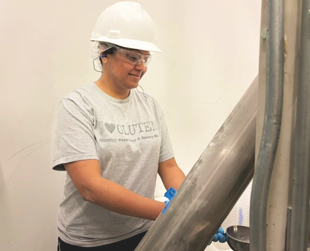
From Academia to Industry: Mennel Scientist Recounts Transition in Food Service
July 27, 2026
Published By: Urvi Shah, Senior Scientist, Research & Development, The Mennel Milling Company
Translating Academic Skills to Industry Value
The food industry values academic research skills more than many students realize. The key is to translate academic work into tangible, real-world solutions and communicate effectively during interviews and professional interactions. Participating in competitions (e.g. pitches, posters, oral presentations), helped me strengthen my ability explain technical projects to non-technical audiences. Learning how to sell your skills and communicate your value is an important part of transitioning into the industry. Having access to the resources and incredible opportunities in academia is a privilege and taking advantage of those events, competitions, workshops, and leadership roles can significantly prepare one for a career in the industry.
The ability to tackle complex problems and develop critical thinking skills in academia translates exceptionally well to industry. Experience in experimental design allowed me to quickly adapt to new projects by designing studies, executing experiments, and interpreting results efficiently. Although I do not come from a traditional milling and baking background, my research experience in food microbiology and product development has been highly transferable to flour processing and food safety applications. This experience reinforced the importance of asking the right questions at the right time.
Common Challenges During the Transition
To start at the very beginning, even before entering the industry, one of the first challenges is to compress years of academic work, research achievements, leadership experiences, and technical expertise into a concise one- or two-page resume. The key is learning how to connect those experiences with employer expectations by tailoring your resume and framing your work in terms of impact, outcomes, and transferable skills.
Another significant adjustment when transitioning into the industry is adapting to ambiguity and faster timelines. Unlike academia, where projects may span several years with a narrow focus, working in the industry often requires managing multiple projects simultaneously while balancing shifting priorities, business needs, and tight deadlines.
Equally important are people management and interpersonal skills. Even without holding a formal managerial title, the ability to collaborate effectively, communicate clearly, manage expectations, and work cross-functionally is invaluable. Technical expertise may open the door, but strong interpersonal skills help you thrive and grow in the industry.
Cross-Functional Collaborations
In academia, researchers often share similar technical backgrounds, approaches to problem-solving, and communication styles. In industry, however, projects are highly cross-functional and involve collaboration among individuals with very different expertise, priorities, and ways of working. Each team (sales, operations, quality, regulatory, purchasing, etc.) brings a unique perspective to a project. Learning to understand and respect these different priorities is essential for successful collaboration.
While following appropriate organizational processes and channels is necessary, building genuine professional relationships is critical. Taking the time to connect with colleagues, explaining project goals, and helping others understand how their expertise contributes to the success of a project creates stronger collaboration and trust. People are often far more willing to support projects when they understand both the purpose and the impact of their involvement.
Leadership experiences through Institute of Food Technologists played a significant role in helping me develop these interpersonal and cross-functional collaboration skills. Opportunities to lead teams, organize initiatives, and communicate with diverse groups prepared me to work effectively across departments and adapt more confidently to the collaborative nature experienced with this change.
Redefining Impact and Success
Success is team-driven and recognition is shared by contributing meaningfully to collective goals rather than individual ownership. The scientific rigor from academia is essential but is balanced with speed and business needs in the industry. For instance, the focus shifts from ‘is this novel’ to ‘is this novel and immediately scalable’ and from ‘publications’ to ‘product launches and process improvements.’
From Academia |
To Industry |
Is this Novel? |
Is this novel and immediately scalable? |
Publications and citations expectations |
Label, customer, and costing expectations |
Delivering a perfect solution |
Delivering a good, validated solution within project timeline |
In closing, academia provided a strong scientific foundation, and industry has allowed me to apply those skills across a wide variety of projects. Together, these experiences have reinforced the importance of continuous learning and interdisciplinary thinking in driving innovation in food. I continue to expand my knowledge through webinars and conferences, recognizing that learning does not end with a degree or a job title. Staying curious opens doors to new opportunities, collaborations, and technical challenges.